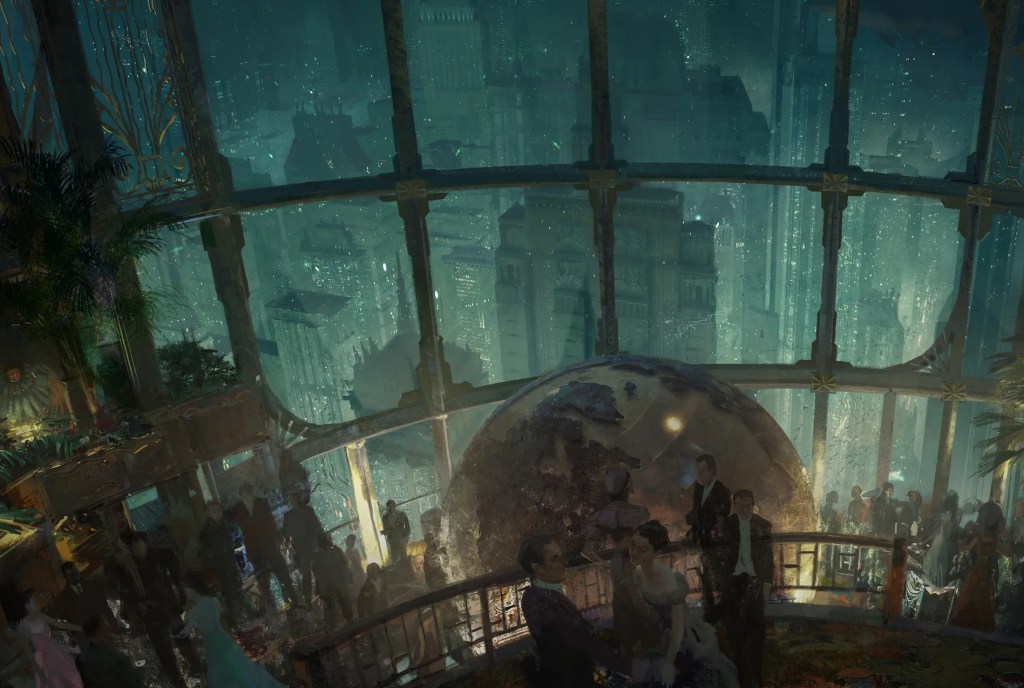
It’s 2007. You’re stood in a Blockbuster, the one in Sunbury Cross. It’s a bit dingy, but it’s the closest place to rent anything from these days. You don’t do it often anyway – you’ve certainly never had the same connection with Blockbuster as you did with Apollo, home of Saturday morning trips with Dad to check out the latest VHS to take home. As you walk past the games section (yes, there was even a games section), you notice a box on the shelf. Bioshock. There’s something intense about it – that hulking metal man on the cover with his giant drill hand, that 18 rating slapped on the box. It feels like forbidden fruit to a freshly twelve pre-teen. Yet alas, it’s for the Xbox 360 – a console you wouldn’t own for another seven years or so – and there’s also no chance in hell your mum’s going to let you take home an 18+ game. Yet you’ve noticed it. You’ve clocked it. And somewhere in the back of your mind, you squirrel it away.
Let’s jump forward six years. Now you’re in a hotel room in Oxford. Coming up to Oxford with Dad has become its own tradition now – you always stay in the same hotel and do the rounds of the typical shops. Yes, we have HMV, Waterstones and Game in Staines, but really… it’s Staines. As much as you’ve always felt it’s a little overhated, it doesn’t quite have the same appeal as Oxford. Anyway, Dad’s having a nap, and you… You’ve just decided that you want an Xbox 360. You’ve saved up your money, and hey, it’s 2013, and the console’s now eight years old. They sell them in CEX for a hundred quid. Might you pull the trigger? You spend some time on your phone looking through Xbox 360 games that you’ve never had the chance to play. Final Fantasy XIII is the one that immediately jumps out. The TV ad when it released definitely hit you with its Leona Lewis backing theme. In fact, it might have hit only you. But it hit, and it was top of the list. You look through some other games, and then you land on it. Bioshock. You’re now seventeen, approaching eighteen. And somehow, that cover still holds the same allure as before. You buy the console when you get back home. From Staines of course.
There’s a certain joy in coming to a console late in its lifespan, as you did with the Xbox 360. All those hits that had been released over the years and passed you by were now at your finger tips, and often for some ridiculously low prices. In the end, Bioshock and Final Fantasy XIII together probably only put you back a tenner or so. If you remember correctly (and you’re fairly certain you do), your dad actually came with you to pick up the console and bring it back to the house. It could’ve even been on the 458 bus that you came back, a bundle of excitement in a red plastic CEX bag on the seat next to you. When you eventually made it back home, thanks bus that somehow felt like it took longer every time you rode it, it was time to set the console up. The big question, of course, was which game you’d try out first. Final Fantasy XIII was there, Leona soundtrack and all, but Bioshock somehow felt like the more enticing prospect.
The whole thing starts with a plane, a present, an explosion, an ocean. You’re immediately disoriented, gasping for air as a sea of flame surrounds you. Nothing on the horizon save a lonely lighthouse standing guard over the wreckage. What choice do you have but to swim towards that – maybe help hides inside. You make it to shore, and creep into the building, only to be greeted by what has now become one of gaming’s most recognisable quotes plastered over the entranceway: “No gods or kings. Only man.” You head deeper into the lighthouse and come across a pod of some description. You step in, turn it on and gawk in amazement at the underwater city that awaits. This is Rapture. And rapture is what you feel.
Location, location, location
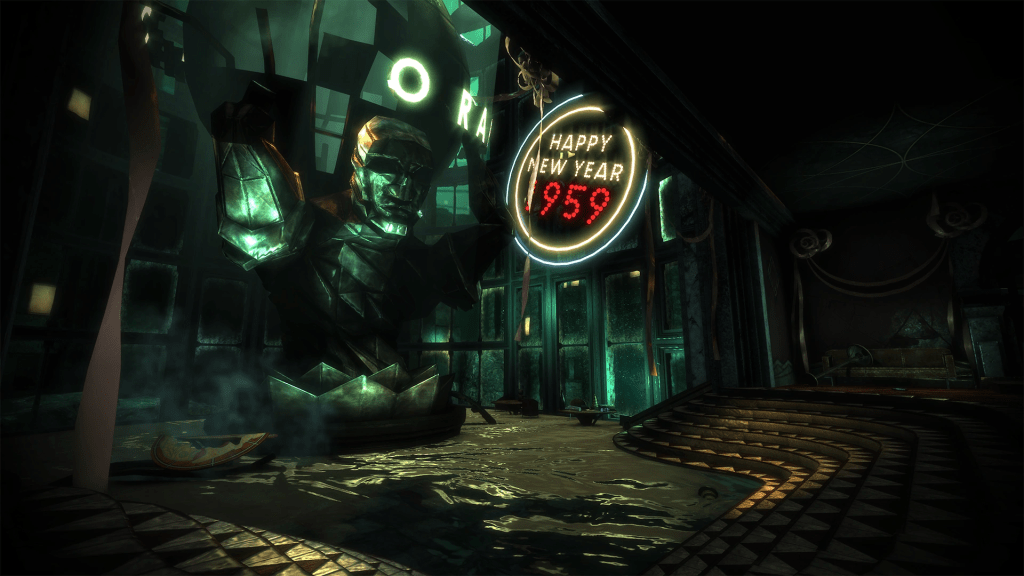
While an increasing number of narrative-led video games feature well-rounded characters with complex motives, a sense of place can often be missing. Looking at some of the popular titles from around the same period as Bioshock’s release, we see many dull brown or grey corridors, unidentifiable jungles, deserts… There is often very little to define the location as a character in its own right. This is where the very cream of the narrative-led crop stands out. Looking at some of the most highly regarded titles of the noughties and early 2010s, we see titles such as Dark Souls and Grand Theft Auto V, games which foreground their locations just as much as any protagonist. Bioshock is undoubtedly one of those.
Emerging from the bathysphere (as Bioshock names its underwater travel system), you are gripped by terror as drug-addled splicers attack. Silhouettes dart across the walls as you make your way through rusted, leaking corridors, picking up recordings from what life was like in the city’s heyday.
For all intents and purposes, Rapture has already been through its own character arc, and here you are, ambling through its carcass and piecing the puzzle together. Bioshock’s dedication to delivering a true sense of place is one of the key elements that immediately elevates it beyond standard first-person shooter fare – a genre you’ve never been particularly interested in – and gives you something meaty to sink your teeth into throughout its campaign.
And so you explore. You creep through decrepit corridors and underwater tubes, slink past enemies that seem too much of a challenge for right now, and then, in the quiet moments, you ponder. You refer back to that initial greeting ‘No gods or kings. Only man.’ You consider Andrew Ryan, the creator of Rapture, and his goal of a true capitalist utopia. You confront the appalling squalor of the lower classes in this so-called ‘dream’ of a city, are sickened by the Little Sisters, the results of unfettered biological experimentation that now meander through the city’s halls gathering a resource known as ADAM. Your heart sinks when you first kill a Big Daddy and see it collapse to the ground, the little girl it was protecting crying alongside.
You balk at the irony of Ryan’s message as he reigns monarch over his ruined city. You feel an uncomfortable tug that only grows stronger in the almost twenty years since that day in Blockbuster, and the thirteen or so years since you first played the game – an unquestionable reflection of the direction our own society has continued to move, uber-capitalism going full mask off in the bid for more, more, more, as data centres soak up our resources, and human lives are expendable at the altar of the great machine. Was Bioshock the only media to pick up on the warning signs? Far from it. Does that dilute the discomfort that sits in your chest when you look at the world around you in 2026? Not at all.
Shifting sands
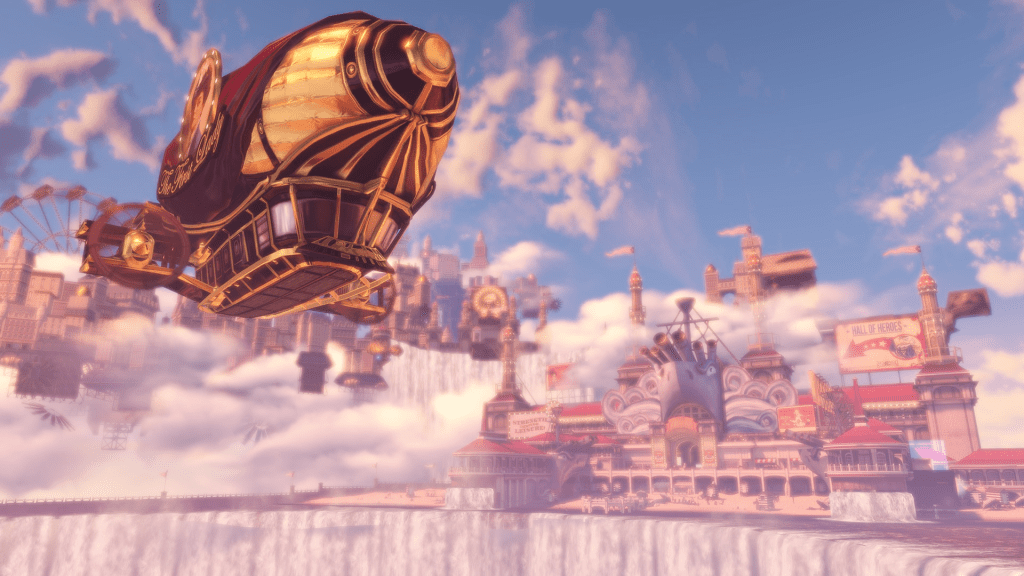
As the series continued on, through Bioshock 2 and into 2013 release Bioshock Infinite, its examination of societal construction shifted from economic theory to racial tensions and meta-commentary. Yet its commitment to delivering philosophical narratives through an impressive dedication to location never wavered. While direct sequel Bioshock 2 once again took us to Rapture, Infinite launched us into the clouds to visit Columbia, a fundamentalist religious ‘paradise’ (as long as you were a white straight man, of course). Whereas the first two games sent you down into the depths, Inifinite casts you upwards, with the same breath-taking reveal of its city. The opening of Infinite is majestic: as the clouds clear and the city spreads its wings before you, the choral sounds of Will The Circle Be Unbroken? ring out across the landscape. You enter through a flooded church, bathed in candle light, and you pause to take it all in.
It’s a moment that will linger with you. You’ll download a copy of the song to your phone. You’ll play it on car journeys with your mum. The tendrils of Bioshock move beyond the game world, interacting with you across other media. You buy the book, Rapture, and you voraciously read through the history of the city before the fall. You harp on about it to your parents and your friends. Anyone who’ll listen really. You buy a copy of the game for your Mac on sale. You’re going to university soon, and you’re not sure you’ll take your console with you, but you still want to be able to play something.
In total, you’ll end up buying the original Bioshock three times. Bioshock Infinite, four. These are games that have travelled with you, across consoles, across cities, across borders. It’s a narrative thread that has followed you from Oxford, down to your parents’ house, back to Oxford again, then onto Tokyo and back to Cambridge, where you’ll finally, finally, take the time to actually play and finish Bioshock 2. To no-one’s surprise, you like it. To no-one’s surprise, it re-ignites a love for the franchise. And yet for you it’s always been there, on the horizon, the unfinished element of the Bioshock story. Why? Maybe because you know that for now, that’s all the Bioshock there is. Maybe the thought of having a little bit more Bioshock left for you to play is comforting. Yet sometimes, you just need to dive in.
You finish Bioshock 2 swiftly, then plough on to its expansion, Minerva’s Den. The very last piece of the puzzle. It’s great. And then, you’re at the end. You beat the final battle, and you make your way through the tunnels to the final bathysphere, and then you hesitate. Are you ready? You push forward, and you ascend, back through the depths to reach the sunlight. After thirteen years, you’ve finally made it.


 Pop Onion
Leave a comment